| Country | |
| Publisher | |
| ISBN | 9781990981401 |
| Format | PaperBack |
| Language | English |
| Year of Publication | 2024 |
| Bib. Info | 268p. |
| Categories | History |
| Product Weight | 900 gms. |
| Shipping Charges(USD) |
 please select your country
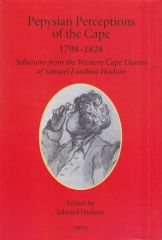
This is the first time that substantial selections from the voluminous diaries of Samuel Eusebius Hudson (1764–1828) have been published. Written by an early British settler of humble social origin but of uncommon education, they are Pepysian in quantity and quality, rich in perceptions, and the more valuable for being unrevised. They cover four periods in the history of the Cape Colony between 1798 and 1828. In the first period, 1798–1800, they present a rare ‘downstairs’ counterpoint to Lady Anne Barnard’s ‘upstairs’ account of the first British occupation. In the next period, 1803–1806, we have Hudson’s later recollections of life at the Cape under Batavian rule. Moving on to the second British occupation, the diaries uniquely preserve the rumours, true and false, swirling through Cape Town in the third period, 1823–1826, and the ‘collective consciousness’ of protest building up against the repressive governorship of Lord Charles Somerset. In contrast, the concluding fourth period, 1826–1828, covers the reforms introduced by his successor, Sir Richard Bourke. In short, this volume provides rare perspectives on the Western Cape from the variety of social positions occupied by Hudson during the first thirty years of British rule. The diarist Samuel Eusebius Hudson (1764–1828) arrived at the Cape on 5 May 1797 as footman to the Cape Colony’s first British Secretary, Andrew Barnard and his wife Lady Anne Barnard. In reality he had been exiled from England in consequence of an adulterous affair with Lady Anne’s youngest sister, Lady Elizabeth Hardwicke (1763–1858), whose footman he had been from 1792 to 1796. Born the son of a country gravedigger, Hudson was exceptionally well educated for a man of such modest origin, thanks to a scholarly clergyman who had tutored him benevolently throughout his childhood, giving him the lifelong intellectual curiosity and Evangelical faith which marks his writings. These include several novels, one of which — written on his way to the Cape in 1797 and embellished in 1826 — makes him South Africa’s earliest known novelist. But it is for his essays on Cape society (some written in 1807, some later) and his voluminous diaries (1796 – 1828, of which only twelve years have survived) that he is chiefly remembered. Once at the Cape, he was soon found a job in the Customs Department, which he held until the colony reverted to Dutch rule in 1803. With his shopkeeper brother Thomas, who had joined him in 1799, he opted to remain during the Batavian Interregnum (1803 – 1806), opening a hotel on Cape Town’s Keizersgracht and — against his Evangelical conscience — buying slaves to staff it. However, after the colony’s recapture by British forces in 1806 and the arrival in 1807 of Lord Caledon (Lord Hardwicke’s future son-in-law) as Governor, Hudson sold up and returned to England, probably summoned to assist in removing his illegitimate son from the Hardwicke succession. When he came back to the Cape in 1814, he found that his brother, in financial straits, had committed suicide. Joining in the entrepreneurial ventures of his friend Frederik Korsten in the Eastern Cape, Hudson attempted to establish a farm on the Gamtoos River in 1818, but this proved impracticable. He then tried trading at Cradock Place (near Algoa Bay) but, with his health deteriorating and an economic recession looming, his store failed in 1821. A further attempt to trade at Uitenhage in 1822 forced him into bankruptcy, after which he had no option but to return to Cape Town and to rely on friends for board and lodging. Living from 1823 to 1826 with the Heurtley family in Dorp Street, and thereafter with the Sala family in Keerom Street, he eked out a bare subsistence as an artist, copyist and teacher of art, waiting in vain for his bankruptcy proceedings to be wound up, so that he could return to England. He died in Cape Town in September 1828, leaving an abundant archive of manuscripts, most of which are now in the safekeeping of the Western Cape Archives and Record Service.